Geographic Tongue, Spots on the Tongue
Lingua geografica is a benign inflammatory condition causing map-like patterns on the tongue. It's often asymptomatic but may cause burning with acidic or spicy foods. No treatment is needed if asymptomatic, but symptom relief can be provided with zinc, lidocaine, or benzydamine.
Table of contents
This article is based on an original article in Swedish which can be found here
BACKGROUND
Geographic tongue (also: migratory glossitis or erythema migrans) is a benign inflammatory condition that occurs on the tongue. The typical appearance of the tongue is a map-like pattern, hence the name geographic tongue. Geographic tongue appears suddenly and can last from days to weeks, months, and years.
Epidemiology
Geographic tongue commonly affects adults but also occurs in children. It is more frequent in women. The global prevalence varies between 1-3%. In previous Swedish epidemiological studies, a prevalence of 5.6 – 8.5% has been demonstrated.
Cause
The cause of geographic tongue is unknown, but some etiological factors have been discussed. Patients with hypersensitivity, food allergies, contact allergies, gastrointestinal disorders, and stress-affected patients seem to be somewhat overrepresented for geographic tongue. In rare case reports, patients with seborrheic dermatitis, Reiter's syndrome, patients with hormonal disorders, or newly diagnosed diabetes have been described clinically with geographic tongue changes, but the relationship is not mapped out.
Geographic tongue histologically resembles psoriasis with inflammatory infiltrates of PMNL (polymorphonuclear leukocytes), so-called Munro’s abscesses. However, patients with geographic tongue do not show an increased prevalence of psoriasis.
An increased prevalence of HLA-B15 has been noted in atopic individuals with geographic tongue changes. An HLA association through an increased prevalence of HLA Cw6, DR5, and DRW6 antigens and a decrease of B51 antigen can sometimes be seen in patients with geographic tongue.
SYMPTOMS/CLINICAL FINDINGS
The condition is usually asymptomatic and does not require treatment. Geographic tongue is typically localized to the dorsum of the tongue and/or the lateral borders, but geographic changes can also occur on other mucous membranes in the oral cavity, such as the floor of the mouth, buccal mucosa, inner lips, and gingiva. The changes are then referred to as geographic stomatitis. Most patients are asymptomatic but may sometimes describe a burning sensation associated with acidic or spicy foods.
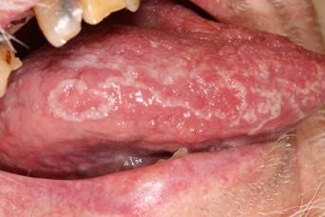
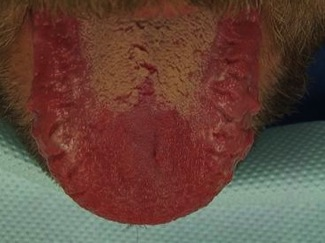
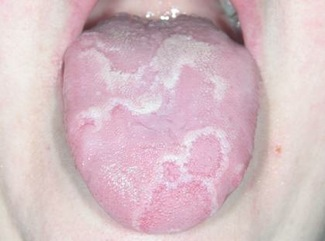
The typical clinical appearance includes solitary or multiple erythematous areas with yellow-white, garland-shaped, and often well-defined zones resembling a landscape or a map on the dorsum of the tongue.
Atrophy of the filiform papillae occurs centrally in the lesion. In the yellow-white areas, the inflammatory reaction is present. If the changes start at multiple points simultaneously, the marginal zones may merge into a "map tongue." The changes regress spontaneously but can quickly recur in another part of the tongue and are sometimes referred to as lingua areata migrans. The change cannot be scraped off, unlike candidiasis (pseudomembranous candidiasis). Geographic tongue is associated with fissured tongue, but the relationship is not mapped out.