
Mandibular Fractures
Mandibular fractures are common in trauma and require thorough imaging diagnostics. Treatment, either closed or surgical, is tailored to the injury's extent and the patient's condition. Postoperative follow-up and rehabilitation are crucial for healing and function.
Table of contents
This article is based on an original article in Swedish which can be found here
BACKGROUND
The mandible is a cosmetically and functionally important structure in the facial skeleton. The mandible forms part of the framework of the face and also acts as a shock absorber for impacts to the head region. The chin is a prominent point, and fractures of the mandible are common in traffic accidents, assaults, falls, and sports injuries. The most common types of fractures are condylar neck/head fractures and angle fractures. It is not uncommon to see a combination of different mandibular fractures, or combined with fractures in the midface. Predilection sites are muscle attachments and areas where tooth roots create weakening zones.
Mandibular fractures are classified according to their location:
- Condylar head/neck fractures
- Ramus fractures
- Coronoid process fractures
- Angle fractures
- Body fractures
- Parasymphyseal fractures
- Symphyseal fractures
- Alveolar process fractures
This article discusses all types of mandibular fractures excluding condylar head/neck fractures.
For these, see separate article: Mandibular Condyle fractures
Epidemiology
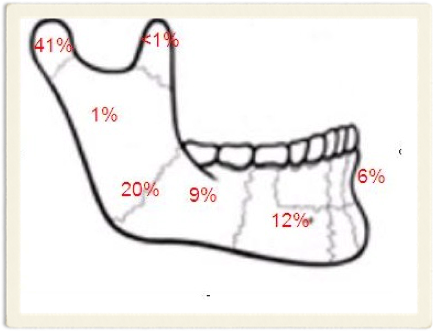
Mandibular fractures are significantly more common among men (77%) compared to women (23%). Furthermore, mandibular fractures account for over 80% of all jaw fractures. Assault (40%) is by far the most common cause of mandibular fractures, closely followed by traffic accidents (29%) and falls (21%). Sports and work-related causes account for over 8% of mandibular fractures. Gunshot injuries constitute a small portion of mandibular fractures in Sweden. The distribution of mandibular fractures is shown in the image below, indicating that condylar and angle fractures are overrepresented.

